

16 Nov Instant withdrawal casino pending periods verification delay
Understanding Pending Periods in Fast Payouts
The word instant often hides a conditional promise. A site may advertise instant withdrawals but restrict them to a particular method, a tiered account status or a capped amount. Before choosing, check which payment method carries the instant label and what limit accompanies it. A low-limit instant option suits small regular wins; a higher-limit option with a longer approval time suits larger sums.
Daily, weekly and monthly withdrawal caps
Withdrawal caps are the ceiling on how much you can take out, not the speed at which the casino processes it. A site may approve your request in an hour yet still return only a fraction of the balance because of a daily limit. That distinction matters more than advertised processing times when you are chasing a large win.
How the three time windows stack up
Daily, weekly and monthly caps usually build on one another instead of replacing each other. A £500 daily ceiling does not mean £500 per day for a week; it typically means £3,500 per week, and a monthly cap then overrides both. Withdraw £500 every day for seven days and you have reached the weekly total while still having room under a £10,000 monthly figure. Withdraw £2,000 on Monday and £2,000 on Tuesday and the weekly cap stops you before Wednesday.
When the cap bites hardest
The restriction lands differently depending on your session size. A player withdrawing a £120 bonus win often hits nothing at all; the money arrives in full within the site’s processing window. A £5,000 session win usually triggers a split payout, with the excess held until the next window opens. That delay is a function of the cap, not of slower banking. Some operators publish the exact figures in their payments terms, others leave them in account settings. If you cannot find them, assume the lower cap and plan your withdrawals around it.
Withdrawal limits at Caliente depend on the payment method and account verification status. The same request may be approved at one ceiling today and rejected tomorrow if the verification file is incomplete. This is why the limit is never a fixed number you can write down and rely on, and why the practical step is to complete identity verification before players build a balance they intend to cash out. Processing times follow the same logic: e-wallets are typically faster than bank transfers, but a request routed to the slower channel will not clear just because you completed the paperwork. Verify early, then pick the method that matches your deadline.
Operator comparison: operator details
Rollerbet and Caliente raise different questions here, from operator profile to operator credentials.
| Brand | Details |
|---|---|
| Rollerbet | 1-3 working days; e-wallets fastest |
| Casinoper | Not available to UK players; no data |
| thephonecasino | Varied speeds; no internal fees noted |
| wish bingo | No platform fees; 24h-3 days processing |
| caliente | Not licensed in UK; focused on LatAm markets |
The faster operators typically hold your money for hours after approval, then push it straight back to the card or e-wallet you deposited with. The slower ones queue everything until their next batch, which often means waiting overnight or through a weekend. That gap is not a glitch; it is a deliberate trade. You get instant access to your funds at the price of a fee, or you pay nothing but wait for the bank to catch up.
Read the credentials for Caliente in the context of the market they cover.
Rollerbet: Withdrawal Duration and Costs
Rollerbet processes withdrawals within 1 to 3 working days for most payment methods, including Visa, Mastercard, PayPal, Skrill, and Neteller. The platform does not explicitly list internal transaction fees for standard payouts, but users should check with their financial provider for potential costs. Faster access to winnings is usually associated with e-wallet options compared to traditional bank transfers or card withdrawals, which may take longer due to intermediary processing steps.
Casinoper: Accessibility Restrictions
Casinoper operates under a Curacao eGaming license and does not hold a UK Gambling Commission licence, making it unavailable to players physically located in the United Kingdom. Therefore, information regarding fees and withdrawal processing times for UK residents is not applicable. The site restricts access based on regulatory compliance, meaning British players cannot utilize its payment systems or request payouts from within the jurisdiction.
thephonecasino: The Phone Casino: Payment Methods and Timelines
The Phone Casino supports major debit cards and e-wallets, with withdrawal speeds varying by method. E-wallet transactions are typically processed faster than card withdrawals. While the operator does not impose its own transaction fees, external banking partners might charge for currency conversion or transfer services if applicable. Identity verification is required before funds can be withdrawn, ensuring compliance with UK regulations and preventing fraudulent activity.
Wish Bingo: Fee Structure and Processing Speed
Wish Bingo charges no internal fees for deposits or withdrawals, though bank providers may apply their own charges. Withdrawal processing typically takes between 24 hours and 3 business days, depending on the chosen method. E-wallets generally offer faster access to funds compared to card transfers. Players must complete identity verification before any payout is released, and large amounts may trigger additional security checks that extend the timeline.
Highflybet casino | offshore fund protection risks
Caliente: Market Focus and Regulatory Status
Caliente operates primarily in Latin American markets, particularly Mexico, and does not hold a UK Gambling Commission licence. For players in the United Kingdom, this means direct access to their payment infrastructure is restricted or unavailable. Consequently, specific details on fees and withdrawal processing times for the UK market cannot be confirmed, as the brand’s operational framework is designed around currencies like the Mexican Peso and local payment methods instead of GBP transactions.
When a fee actually applies and when it does not
When the casino charges, and when the player does not
A fee is not automatic on a payout. It depends on two things: the payment method you chose, and the written rule attached to that method for your account tier. Most UK fast-payout operators do not add a charge to a withdrawal by default; the fee appears only where the operator has documented one, usually in the payment or banking section.
Where the charge really sits
The clearest split is between a fixed transaction fee and a currency or exchange loss. A fixed fee reduces the amount that lands in your bank account by a stated sum, so a £50 withdrawal with a 2% fee arrives as £49. That is different from an exchange rate applied when you hold bonus funds in one currency but bank to another; here the reduction comes from the rate, not a line item. One operator may call its charge a processing fee, another a handling charge, and a third may waive it for a specific e-wallet. The only way to know which applies is to read the method row for your account instead of the general bonus terms.
The example that shows the gap
Take a hypothetical £200 withdrawal. If the method carries a 1% handling fee, you receive £198; if it carries no fee, you receive the full £200. The difference is small on a modest amount but scales with size, which is why the fee becomes material once a withdrawal passes a few hundred pounds. Some operators advertise instant cashout with no fee yet restrict that no-fee treatment to a subset of e-wallets, leaving card and bank-transfer withdrawals subject to a charge. That restriction is rarely announced in the marketing text; it lives in the terms table.
What to check before requesting
Look at the withdrawal method list on the operator page and note the fee column for each option, plus the tier at which a fee is waived. If no fee is shown, treat the withdrawal as free but confirm the figure against the current terms page before clicking submit, since operators can change rates without rewording the homepage.
True fortune casino cashier | read your own deposit options
Pending periods and the terms that extend them
When a pending period actually starts
The advertised fast payout only begins once the casino has enough to act on. The clock does not start at the moment you click withdraw; it starts when the request is marked complete in the back office. That distinction matters because most delays people report are not a slow bank transfer — they are a pending period that has not yet begun.
The trigger is a completed request. In most cases the casino will not move funds until it can process a single, self-contained instruction. Until then the status stays pending, and nothing about the payment method’s speed applies. This is why a method described as instant does not guarantee an instant credit: the method only governs the leg after the casino releases the money, not the leg before.
Which terms stretch the pending period
Several account-level conditions extend the pending period, and they sit outside the payment method’s own timetable. The most common are a bonus in play, a wagering requirement not yet met, or a bet placed after the bonus was credited. If a player uses a bonus and then requests a withdrawal before the wagering is cleared, the casino typically holds the request until the requirement is satisfied or the bonus is forfeited. The cashable amount may drop in the same process.
A wagering requirement is the number of times the bonus must be staked before winnings become withdrawable. For example, a £20 bonus with a 35× requirement means £700 of bets must be placed before the associated winnings clear. This figure is an illustration of the mechanism, not an offer from any operator.
Other terms include a maximum cashout limit attached to a bonus, an account balance check, or a self-imposed cooling-off period. Each one pauses the release independently. A maximum cashout of £100 on bonus winnings, for instance, caps what clears regardless of how much was staked.
The practical test is the withdrawal status screen and the bonus terms tab. A completed request shows the pending clock ticking; an incomplete one shows a blocker listed.
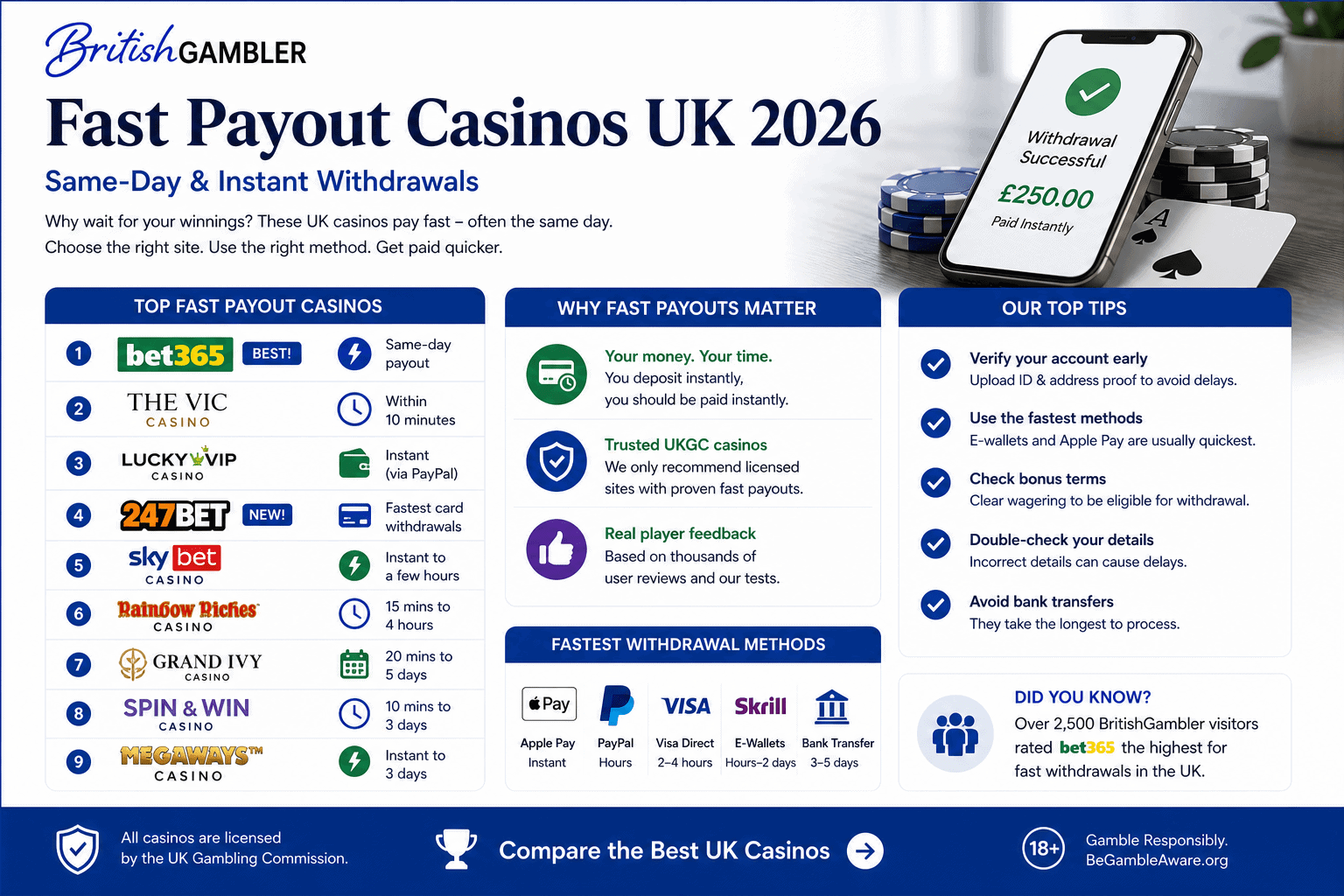
Bonus terms that quietly reduce your cashable amount
A bonus can cut the amount you may take out even before the casino applies any fee. The mechanism is simple: the operator declares part of your money as non-withdrawable, and that declaration lives in the bonus conditions instead of on the payment page, so it passes unnoticed.
Wagering requirements are the most common reducer. Until you meet the stated playthrough, the bonus and often the winnings it generates remain locked. Treat this as a cap on what is withdrawable at any moment, not as a loss. A worked example illustrates the shape: if you deposit £20 and receive a £20 bonus subject to 35x wagering on the bonus’s size, you must generate £700 in qualifying stakes before that bonus cash and its proceeds become cashable. The example is a calculation, not an operator’s offer.
Maximum bonus conversion is a separate and steeper limit. Some terms fix the cashable value of a bonus at a multiple of the deposit or at a fixed sum, regardless of how much you win. Staking £20 on a bonus converted at 4x means £80 is the most you can withdraw from that bonus, even if the balance shows more. Game weighting changes the path to the same result: a slot may count 100% toward the requirement while table games count 10%, so the same number of bets takes longer on the slower games. Check the game list attached to the offer, because the default table game contribution often differs from the summary percentage.
Time limits compress both the wagering route and the conversion. A bonus that expires in 24 hours or a win cap imposed on free spins can leave winnings locked when the clock runs out. Withdrawal requests submitted while wagering is still in progress usually fail, and the pending period then compounds the delay. Inspect the expiry clock and the conversion cap before accepting the offer, because those two numbers determine whether the bonus is worth the extra restriction.
Withdrawals from winnings generated by bonuses face a hard ceiling of £250. Even if a player exceeds the wagering requirements and accumulates larger sums, the excess remains locked. This cap limits the potential return on promotional play, making it suitable for casual entertainment instead of high-stakes profit generation. Players aiming for larger payouts should rely on real-money balances instead.
King johnnie casino free spins 50x wagering explained
Common questions about limits, fees and delay terms
Can a fee apply to every withdrawal?
It depends on the documented arrangement for that operator and method. Some sites charge only above a monthly threshold; others apply a flat charge per transaction. If the amount you can take is limited by the fee itself, the cap effectively shrinks.
Do bonus rules change what a fee takes from?
Yes. A withdrawal restriction tied to wagering can prevent you cashing out even when the method fee is zero. The fee applies to the approved amount, but bonus conditions decide whether that amount exists. Check whether the pending period has ended and whether the wagering is fully cleared before requesting a withdrawal, so the fee is charged on money you can actually keep.
What counts as a deduction, and who pays it?
A casino-imposed fee is charged from the casino’s account for the transfer; a deduction comes straight from the amount you receive. These are different, and a ‘0% fee’ advert can still mean the casino reduces your payout to cover the cost.
The distinction matters because the casino is usually the party that settles with the payment provider, but the contract can name you instead. A receipt from your payment provider may show a transfer fee while your casino statement shows only the net amount paid out. To tell them apart, compare the figure on the payout statement with the figure credited to your chosen method.
Keep the payout terms in view
The delay is usually the operator’s pending period, not a technical failure. A typical window is up to 24 hours for verification, after which approved amounts move to your bank or e-wallet. During that window you may cancel a withdrawal, but only if the request is still awaiting approval. Check whether a bonus was active when you deposited, since wagering requirements can freeze the cashable balance regardless of how fast the method itself pays out. Set a realistic spending limit before playing, and if you find yourself chasing losses, contact GamCare or BeGambleAware, or call the National Gambling Helpline on 0808 8020 133.

Sorry, the comment form is closed at this time.